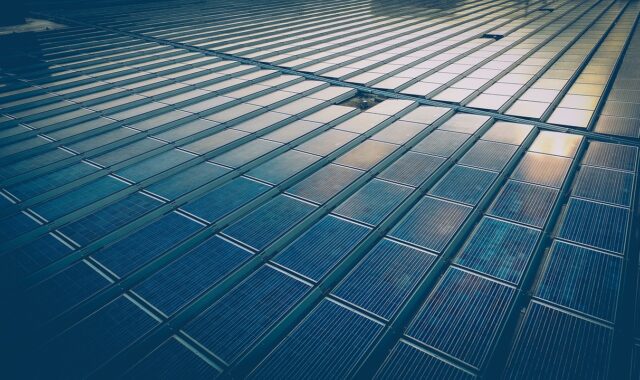
New high efficiency solar panels explained for homes with limited roof space

a[data-rs-seo-link]{text-decoration:underline!important;color:#1a56db!important;cursor:pointer!important;}a[data-rs-seo-link]{text-decoration:underline!important;color:#1a56db!important;cursor:pointer!important;}
What counts as high efficiency now?
New high efficiency solar panels are modules that convert more sunlight into usable electricity from the same roof area. For U.S. homeowners, there is no single official cutoff. A practical benchmark is whether a module sits clearly above mainstream residential efficiency. The U.S. Department of Energy’s 2025Q1 residential benchmark used a representative 8 kWdc rooftop system with twenty 400-watt crystalline silicon modules at 20.4% efficiency. Berkeley Lab’s distributed solar data update reported a 20.9% median module efficiency for U.S. residential systems installed in 2024. In practical terms, panels in the low-20% range are now common, while modules around 22% and above are usually better described as premium efficiency.
The main benefit is space productivity. Higher efficiency does not, by itself, guarantee a lower bill, faster payback or better durability. It means more rated watts can fit into a given area, which matters most when roof space, shade setbacks, roof planes or design rules limit how many panels can be installed.

Why panel efficiency matters more on some roofs
Solar panel efficiency is the share of incoming sunlight converted into electrical power under standard rating conditions. It is related to wattage, but it is not the same thing. Wattage tells you how much power a panel is rated to produce. Efficiency tells you how effectively the panel uses its physical area. A large lower-efficiency panel and a smaller higher-efficiency panel can carry the same watt rating, so homeowners should compare both panel dimensions and rated watts.
For a simple illustration, assume a two-square-meter module under standard rating conditions. Real panel sizes vary by manufacturer, but the relationship is useful:
| Module efficiency | Approximate rated output from 2 m² | What it means on a roof |
|---|---|---|
| 20.4% | About 408 watts | Close to DOE’s 2025 residential benchmark module efficiency |
| 22.0% | About 440 watts | More power in the same panel area |
| 24.0% | About 480 watts | Useful where usable roof area is tight |
That area advantage is especially valuable on small homes, townhouses, roofs with dormers, roofs split into several planes, and sites with fire-code pathways or partial shading. If a home has a large, open, south- or west-facing roof, a slightly less efficient module may still deliver the same annual energy by using more panels, often with a lower equipment premium.
What is changing inside new high efficiency panels?
The current wave of high-efficiency panels is mostly an evolution of crystalline silicon technology, not a full replacement for silicon. The industry has been moving beyond older PERC designs toward n-type architectures and more advanced cell layouts. These designs reduce electrical losses, improve charge collection and allow manufacturers to raise watts per module without simply making panels larger.
| Technology | What it changes | Practical takeaway |
|---|---|---|
| TOPCon | Adds passivated contacts to reduce electron recombination losses | A major route for higher-output mainstream silicon panels |
| HJT | Combines crystalline silicon with thin amorphous silicon layers | Often marketed for strong efficiency and temperature performance |
| Back-contact designs | Move electrical contacts away from the front surface | Can reduce front-side shading and improve appearance |
| Perovskite-silicon tandem | Stacks materials that absorb different parts of the solar spectrum | Promising, but long-term outdoor durability and mass production still need scrutiny |
Public DOE materials describe tandem solar cells as a route to greater use of the solar spectrum, and DOE notes that perovskite cells have advanced quickly in laboratory efficiency. Laboratory cell records and commercial rooftop panels, however, are not the same thing. A research cell can be very small, highly controlled and not yet proven for decades outdoors. A residential product must withstand heat, humidity, wind, hail risk, electrical stress and repeated temperature cycles.
That is why “new” should be read carefully in solar marketing. It may refer to a genuinely different cell architecture, a new module format, a higher power class, a revised warranty package or only a refreshed product name. The useful question is not whether the panel sounds advanced, but whether its datasheet shows verified efficiency, a credible power warranty and compatibility with the roof and inverter design.
Efficiency is only one part of annual energy production
A high efficiency rating is measured under standard test conditions. Real annual energy production depends on several other variables, including roof orientation, tilt, shade, local weather, heat, inverter selection, wire losses, soiling and the system’s dc-to-ac sizing. Two systems with the same panel efficiency can produce different annual kilowatt-hours if one roof faces southwest with little shade and the other is split across shaded east and north-facing planes.
Temperature is another reason to look beyond headline efficiency. Solar panels are tested at a cell temperature of 25°C, but rooftop panels often run hotter in summer. As temperature rises, output falls. Many premium modules advertise favorable temperature coefficients, but the difference should be modeled in expected annual production rather than assumed to create a dramatic gain.
Durability also matters. DOE consumer guidance says silicon modules are expected to last 25 years or more and still produce more than 80% of original power after that period. NREL materials on module lifetime generally describe degradation as slow, often below 1% per year, though actual rates vary by product, climate and installation quality. A panel with slightly lower nameplate efficiency but stronger warranty terms, better installation practices and lower degradation may compete well over the life of a system.
Cost and payback trade-offs
High efficiency has economic value when it increases useful system size on a constrained roof or reduces area-related costs. DOE’s solar cost benchmark framework explicitly separates costs that scale with watts from costs that scale with module area. That distinction helps explain why better efficiency can reduce some balance-of-system costs. If a crew can install more watts using the same roof area, racking, roof attachments and some labor may be used more productively.
Still, homeowners buy complete systems, not panels alone. SEIA and Wood Mackenzie’s Q4 2025 Solar Market Insight reported that module prices declined year over year as higher-power TOPCon technology expanded, while residential system prices also reflected inverters, labor, racking, permitting, overhead and local market conditions. The practical takeaway is straightforward: a premium panel can be worthwhile, but only when the full installed quote supports the value. See also: Buying Guides.
When comparing options, ask for the cost per expected first-year kilowatt-hour and the cost per warranted lifetime kilowatt-hour, not just the cost per watt. If two designs produce nearly the same annual energy and one uses a more expensive premium module, the higher efficiency may be unnecessary. If the premium design fits an extra 1 to 2 kWdc on a roof that cannot accept more panels, the same premium may be justified.
How to compare quotes without overpaying
Use a disciplined comparison process before choosing new high efficiency solar panels. The goal is to evaluate the system as an energy-producing asset, not as a bundle of attractive datasheet numbers. For more homeowner-oriented comparisons, visit the Efficiency Guides section.
- Compare annual production, not only system size. A 9 kWdc system with better shade conditions may outperform a larger system on a compromised roof.
- Check panel efficiency and panel area together. Confirm that a higher watt rating is not only the result of a physically larger module.
- Request the full datasheet. Look for efficiency, product warranty, performance warranty, temperature coefficient, degradation terms and mechanical load ratings.
- Ask why the design uses premium modules. A good reason might be limited roof area, difficult setbacks or a target battery-charging profile. A weak reason is simply that the panel is “new.”
- Review inverter pairing. Microinverters, optimizers and string inverters can all work, but the design should account for panel current, voltage, shade and clipping.
- Model realistic shading. Even high-efficiency panels cannot recover sunlight that never reaches the array.
- Separate equipment premium from financing effects. Monthly payment comparisons can hide the true cost difference between module options.
Should you replace existing panels with higher-efficiency ones?
For most functioning rooftop systems, replacement solely for higher efficiency is hard to justify. DOE guidance from June 25, 2024 emphasized that keeping an existing system is usually more beneficial when it is operating well, because paid-off solar can continue producing electricity even as output slowly declines. Replacement may make more sense if the roof is already being replaced, the old system has serious reliability issues, or the homeowner needs more production but cannot add roof area.
Before replacing older panels, compare three alternatives. First, can more panels be added on an unused roof plane or accessory structure? Second, would an inverter update, monitoring repair or maintenance improve output? Third, would storage help shift solar production into evening hours if utility rates make self-consumption more valuable? New high-efficiency panels can be part of the answer, but they are not the only answer.
Frequently asked questions
Are higher-efficiency solar panels always better?
No. They are better at producing more watts from the same area, but value depends on the roof, quote price, warranty, expected annual production and system design. On a spacious roof, standard high-quality panels may be more economical.
What efficiency should I look for in a residential solar panel?
As a practical current benchmark, panels around 20% to 21% are mainstream, while panels above roughly 22% are commonly positioned as premium efficiency. The best choice is the one that produces the needed annual energy at a competitive lifetime cost.
Do high-efficiency panels work better in shade?
Not necessarily. Efficiency does not remove the impact of shade. If shade is a major issue, the system design, panel placement and inverter-level electronics may matter more than a small difference in module efficiency.
Are perovskite-silicon tandem panels ready for most homes?
Tandem technology is one of the most important efficiency pathways, but homeowners should be cautious about treating laboratory progress as equivalent to widely proven rooftop products. Long-term durability, bankable warranties and large-scale manufacturing remain key checkpoints.
What is the simplest way to judge whether premium efficiency is worth it?
Ask whether the premium module increases the system’s expected annual kilowatt-hours in a way that a lower-cost design cannot match. If the answer is yes because roof area is constrained, premium efficiency may be valuable. If the answer is no, compare total lifetime cost before paying extra.